Error Propagation with ?: So Simple, So Smart
 Chris Woody Woodruff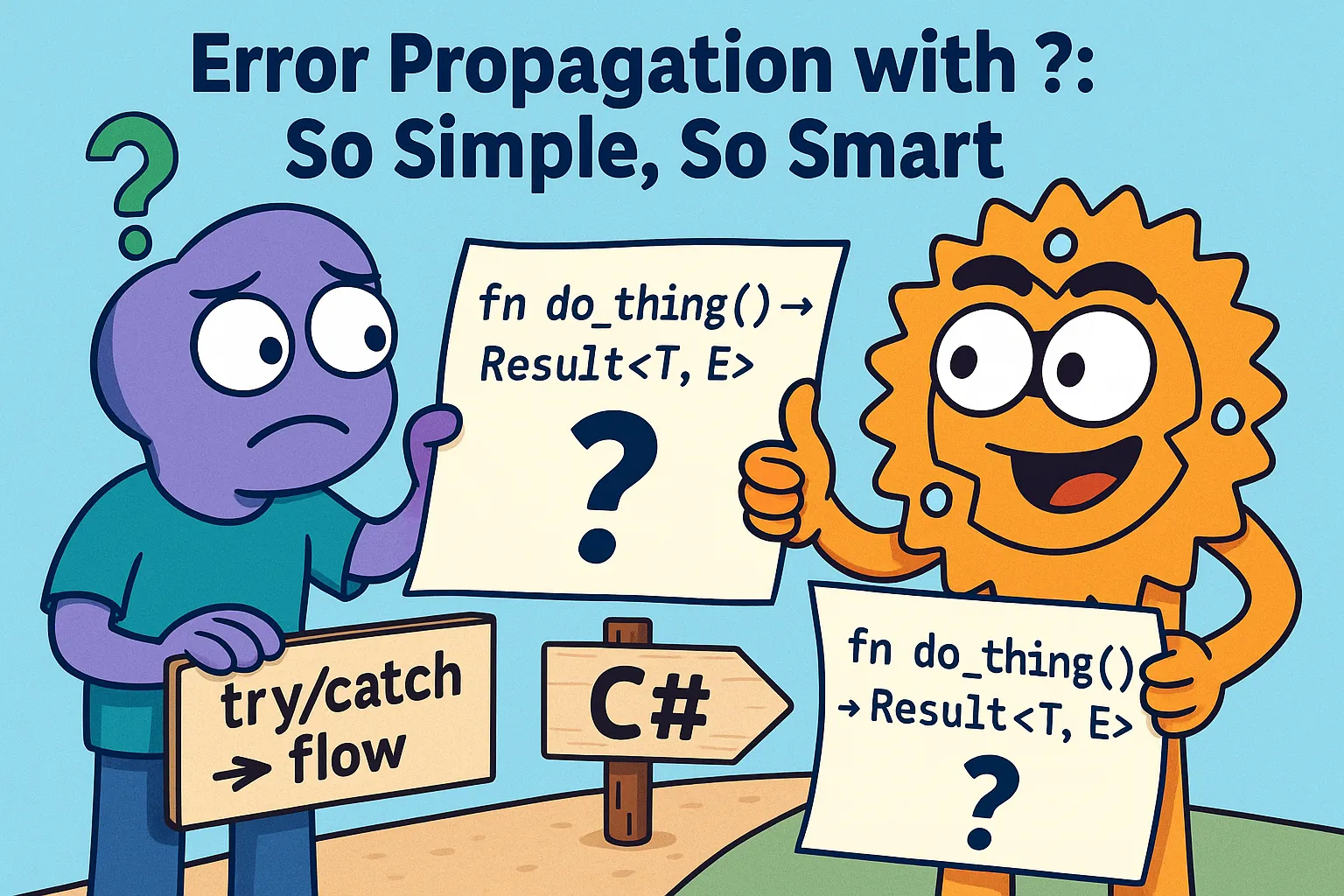
Day 24… today we’re digging into one of my favorite “why doesn’t every language have this?” features in Rust: the ? operator.
If you’ve spent any time in C#, you’re no stranger to the good old try/catch flow. You wrap some code in a try, you catch the exception, and you hope you didn’t forget to check for null or some unexpected state.
Rust takes a different approach with Result<T,E> and the magic of the ? operator. It keeps your error handling clean, readable, and safe without the overhead (or drama) of exceptions.
The Usual Suspects: C# try/catch
Let’s start with what you know:
try
{
    var data = File.ReadAllText("config.txt");
    Console.WriteLine(data);
}
catch (IOException ex)
{
    Console.WriteLine($"Failed to read file: {ex.Message}");
}
It works. But it’s noisy. And if you’re calling multiple methods that could throw, your try/catch blocks can quickly become a tangle of indentation and exception juggling.
Rust’s Way: Result + ? = Clean
In Rust, instead of exceptions, functions return Result<T,E>. And instead of wrapping every call in a match or if statement, you can use the ? operator to automatically return early if there’s an error.
Here’s a function that reads a file and propagates errors up the call stack:
use std::fs::File;
use std::io::{self, Read};

fn read_file_contents(path: &str) -> Result<String, io::Error> {
    let mut file = File::open(path)?; // if this fails, the error is returned immediately
    let mut contents = String::new();
    file.read_to_string(&mut contents)?; // same here
    Ok(contents)
}

fn main() {
    match read_file_contents("config.txt") {
        Ok(data) => println!("File contents: {}", data),
        Err(e) => println!("Failed to read file: {}", e),
    }
}
No try, no catch, no drama. The ? says: “If this operation fails, bail out and return the error. Otherwise, keep going.”
Why This Is So Smart
The brilliance of the ? operator is in its simplicity:
-
It reduces boilerplate. No need for repetitive match statements.
-
It’s explicit. You can see exactly where errors might occur.
-
It’s enforced by the type system. Rust won’t let you forget to handle an error.
Compare that with chaining methods in C#, where you either:
-
Hope nothing throws, or
-
Wrap everything in
try/catch, or -
Check every return value manually if you’re avoiding exceptions.
Even Cleaner: Using thiserror and Custom Errors
Rust makes it easy to define your own error types and still use ?. Example:
use thiserror::Error;

#[derive(Error, Debug)]
pub enum MyError {
    #[error("IO error: {0}")]
    Io(#[from] io::Error),
    #[error("Invalid input!")]
    InvalidInput,
}

fn read_file(path: &str) -> Result<String, MyError> {
    let mut file = File::open(path)?; // auto-converts io::Error into MyError::Io
    let mut contents = String::new();
    file.read_to_string(&mut contents)?;
    Ok(contents)
}
This keeps your error types meaningful without sacrificing the ease of ?.
Wrapping It Up
Error handling is one of those areas where Rust’s philosophy really shines: catch problems early, handle them clearly, and avoid surprise runtime crashes.
The ? operator makes error propagation so simple that once you get used to it, going back to nested try/catch blocks feels like using a fax machine.
Tomorrow, we’ll talk about panic and how Rust handles those truly unrecoverable situations. See you then!