Slices and Strings with Rust: Goodbye C# StringBuilder?
 Chris Woody Woodruff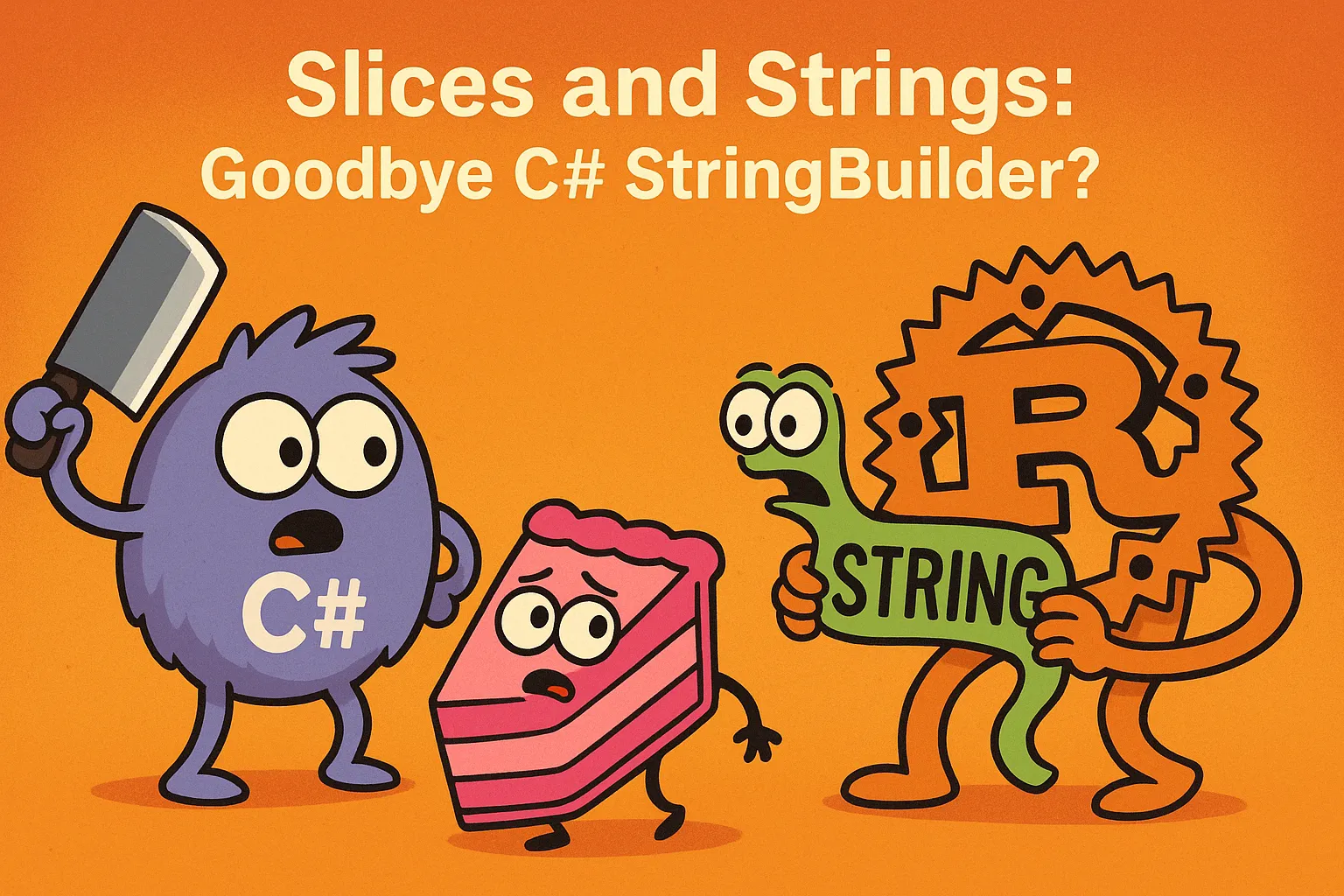
When you’ve spent years writing C#, you get really comfortable with string being immutable, Span<T> being your performance trick, and StringBuilder being your go-to hammer when a for loop starts building text.
And then you start learning Rust.
Suddenly, String isn’t immutable. &str looks suspiciously like a Span<char> in disguise. And you realize… wait, do I even need a StringBuilder anymore?
Today on Day 12, I dove into slices and strings in Rust, and let me tell you, it’s a whole new world, but a surprisingly elegant one.
Strings in C#: Immutable, Safe, and Everywhere
You probably know this dance by heart:
string name = "Alice";
string upper = name.ToUpper();
Console.WriteLine(name); // still "Alice"
Strings in .NET are immutable reference types backed by UTF-16. If you want to modify one, you either:
-
Reassign the variable, or
-
Reach for a
StringBuilderif performance matters
You also get tools like Span<char> and Memory<T> for performance-critical code when slicing or manipulating buffers.
Strings in Rust: A Bit More to Unpack
Rust splits strings into two distinct types:
-
String– a growable, heap-allocated UTF-8 string -
&str– a string slice, referencing a part of aString(or a string literal)
fn main() {
    let name = String::from("Alice");
    let greeting = format!("Hello, {}!", name);
    println!("{}", greeting);
}
You can modify String directly:
let mut msg = String::from("Hello");
msg.push_str(", world");
println!("{}", msg); // Hello, world
Yep, no StringBuilder needed. Just mutate the String.
&str: The Slice-y Sidekick
The &str type is like a read-only view into a String. Think of it like a Span<char> in C#, but with guaranteed safety and lifetimes checked at compile time.
fn greet(name: &str) {
    println!("Hi, {}!", name);
}

fn main() {
    let user = String::from("Alice");
    greet(&user); // passing a &str
}
You can even slice strings with range syntax:
let text = String::from("Rustacean");
let slice = &text[0..4]; // "Rust"
println!("{}", slice);
But here’s the catch: Rust strings are UTF-8 encoded. So slicing is byte-based, not char-based. Slicing in the middle of a multibyte character? Compiler panic.
Comparing with C#: Span Vibes
Rust’s &str gives you the safety and flexibility of a C# ReadOnlySpan<char>, but with much tighter compiler enforcement.
And if you want something like a Span<u8> in Rust, just use a &[u8] slice:
let bytes = b"hello"; // byte string literalThere’s no need to pin memory, worry about unsafe access, or juggle multiple string types. Rust’s system is consistent, even if it’s more verbose at times.
UTF-8 vs UTF-16: Why It Matters
C# strings are UTF-16. That means most common characters (including emojis) take 2 bytes, but some use surrogate pairs. Slicing blindly is usually okay, but not always safe.
Rust strings are UTF-8, which is smaller for ASCII and more web-native. But it also means:
let smile = "😊";
println!("{}", &smile[0..1]); // ERROR!
Why? Because you’re trying to cut a byte in the middle of a 4-byte emoji. Rust protects you from doing that by accident. Thanks, borrow checker (again).
Do You Ever Need StringBuilder in Rust?
Not really.
With String, you can:
-
Append with
push_str()orpush() -
Format with
format!()(likestring.Format()or C# interpolated strings) -
Replace substrings, trim, split… everything you expect
If you need high-performance streaming or chunked writes, you’d probably reach for std::fmt::Write or buffered I/O, but for most devs, String just does the job.
Final Thoughts: It’s Simpler Than It Looks
At first, having String and &str felt like one type too many. But now? I get it.
Rust separates string ownership from string views. And once you embrace slices, you realize they’re everywhere: strings, arrays, buffers. It’s one concept to learn that applies to multiple types.
Tomorrow, we examine shadowing, specifically re-declaring variables with the same name intentionally. It may sound unusual, but it’s actually quite elegant. Stay tuned.