Move Semantics in Rust: What Just Happened to My Variable?
Okay, so picture this: you’re cruising along in your nice, type-safe Rust code, and suddenly… your variable vanishes.
Not literally, of course. But the compiler throws a fit, and you’re left staring at an error that says something like:
“value borrowed here after move”.
Wait, move?
Welcome to move semantics, Rust’s very opinionated way of managing memory and keeping you from accidentally using things that don’t belong to you anymore.
Today’s post is a follow-up to yesterday’s crash course in ownership and this one might sting a little at first if you’re coming from the comfy world of .NET’s reference types. But stick with me. It’s about to make sense.
Continue Reading
Ownership in Rust: The Most C++-ish Thing I’ve Loved (and I Mean That in a Good Way)
Let’s get one thing out of the way: as a C# developer, I’ve never had to think too hard about memory. The garbage collector (GC) is always there, lurking in the background, sweeping up after my code, like a very polite, very invisible butler.
But Rust? Rust doesn’t do garbage collection. There’s no GC.Collect(), no memory profiler needed to chase leaks from forgotten Dispose() calls. Instead, Rust gives you something bold, powerful, and… at first, kind of intimidating:
Ownership.
Today’s post kicks off Week 2 of my Rust adventure, and it’s all about how this one idea changes everything.
Continue Reading
Reflections on Week 1: Rust’s Minimalism Hits Different
Seven days into learning Rust, and I feel like I’ve been through a developer bootcamp with a compiler that doubles as a personal trainer. It doesn’t let you slack, but it does make you better.
This week, I went from installing the toolchain to wrestling with immutable variables and puzzling over semicolons in return statements. As a C# developer, I expected syntax differences, but I didn’t expect the philosophical shifts.
Let’s recap what stood out, what stung, and why I’m still excited to keep going.
Continue Reading
Rust Scalar and Compound Types: Where Are My C# Classes?
When I first started exploring Rust, one of my instincts was to reach for a class. You know the drill. Need to model some data? Write a class, slap a few properties on it, and maybe add a constructor or two.
But Rust had other plans.
On Day 6, I dug into Rust’s scalar and compound types and quickly realized that Rust doesn’t want you to start with classes. Instead, it hands you a small set of powerful primitives and says, “Let’s build something lean.”
Continue Reading
Functions in Rust: Familiar Yet Different
Today’s Rust lesson hit a familiar note but with a twist. Writing functions in Rust feels almost like writing them in C#. Until, of course, the compiler reminds you that this language doesn’t always play by the same rules.
On Day 5 of my Rust-for-C# developers journey, let’s break down function definitions, type inference, return values, and where Rust and C# shake hands… and where they give each other a suspicious side-eye.
On Day 5 of my Rust-for-C# developers journey, let’s break down function definitions, type inference, return values, and where Rust and C# shake hands… and where they give each other a suspicious side-eye.
Continue Reading
Variables in Rust: Let Me Be Immutable
So today, I ran head-first into a Rust design decision that made me pause and go, “Wait… really?”
In C#, I can declare a variable with var and change it later. No fuss. In Rust? Not so fast. Your variables are frozen solid if you don’t explicitly ask for mutability. Welcome to Day 4: the world of let, mut, and what happens when your muscle memory meets a strict compiler.
Continue Reading
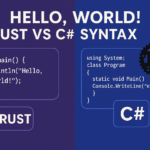
Hello, Rust! Hello, World! Rust vs C# Syntax
Let’s be honest—every new language journey begins the same way: with a humble “Hello, World!” It’s the developer’s rite of passage. So today, on Day 3 of my 42-day Rust challenge, I’m writing the most iconic two-word phrase in programming in both C# and Rust… and then tearing it apart.
Because while the output is the same, what these two languages make you say to get there reveals a lot about how they think.
Continue Reading
dotnet new, Meet cargo new: A Tale of Two CLIs
It’s Day 2 of my journey learning Rust as a longtime C# developer, and today I took the plunge: I installed Rust and created my first project. The whole thing felt a bit like unpacking a new toolbox—familiar enough to recognize the tools, but different enough that I had to check the manual.
Continue Reading
Why Rust? A C# Developer’s Journey Begins
Today marks Day 1 of my 42-day challenge to learn Rust—with a twist. I’m not approaching this as a blank-slate beginner. I’m bringing along years of C# experience, mental muscle memory from countless LINQ expressions, async/await workflows, and enough IEnumerables to make your head spin.
But now? I’m learning a language that doesn’t have a garbage collector, doesn’t throw exceptions the same way, and thinks null is a bad idea.
Continue Reading
From C# to Rust: A 42-Day Developer Challenge
I’ve spent over a decade writing C# and building solutions on .NET. But for six weeks, we will step outside the managed world of garbage collection and runtime JIT to dive headfirst into Rust—a systems programming language that promises performance, safety, and no nulls.
Over the course of 42 days, we will learn something new about Rust every single day. We will fight the borrow checker. We will make mistakes. And I will blog it all from the perspective of a C# developer trying to make sense of it.
Continue Reading